
Most families who inherit a house in Florida never ask about taxes. It doesn’t come up in the first conversation, or the second. Then somewhere in the middle of deciding what to do, someone finally says it out loud: are we going to get hit with a huge tax bill if we sell this?
I had that exact question come up recently on a probate I’m working right now, and it’s worth answering properly — because the real answer is usually far better than what people fear, and because the thing that actually costs families money isn’t the tax at all.
This is general information, not tax advice. Every estate is different and you should talk to a CPA about your specific situation.
Do You Pay Capital Gains on an Inherited House?
Yes, you can owe capital gains tax when you sell an inherited house. But you are almost certainly not taxed on what you think you are.
You are not taxed on the difference between what your parent paid for the house and what you sell it for. You’re taxed on the difference between what the house was worth on the day they died and what you sell it for.
That single distinction is the whole ballgame, and most people have it wrong.
How Stepped-Up Basis Works
When you inherit property, the cost basis “steps up” to the fair market value as of the date of death. Whatever your parents paid in 1978 stops mattering the moment the property passes to you.
Here’s what that means in practice:
Scenario A — sell soon after death. Mom passes away and the house is worth $250,000. You sell it a few months later for $250,000. Your basis is $250,000, your sale price is $250,000, and your taxable gain is essentially zero. After selling costs, you may have no gain at all.
Scenario B — sell decades later. Mom passes away in 2000 when the house is worth $50,000. The family holds it for 25 years and sells for $250,000. Your basis is still $50,000 — the value the day she died. Now you have a $200,000 gain, and that’s what gets taxed.
Same house, same sale price. Completely different tax outcome, driven entirely by when the sale happened relative to the death.
That’s not a hypothetical. That’s the probate I’m working right now.
Stepped-Up Basis Example: A House Inherited in 2000
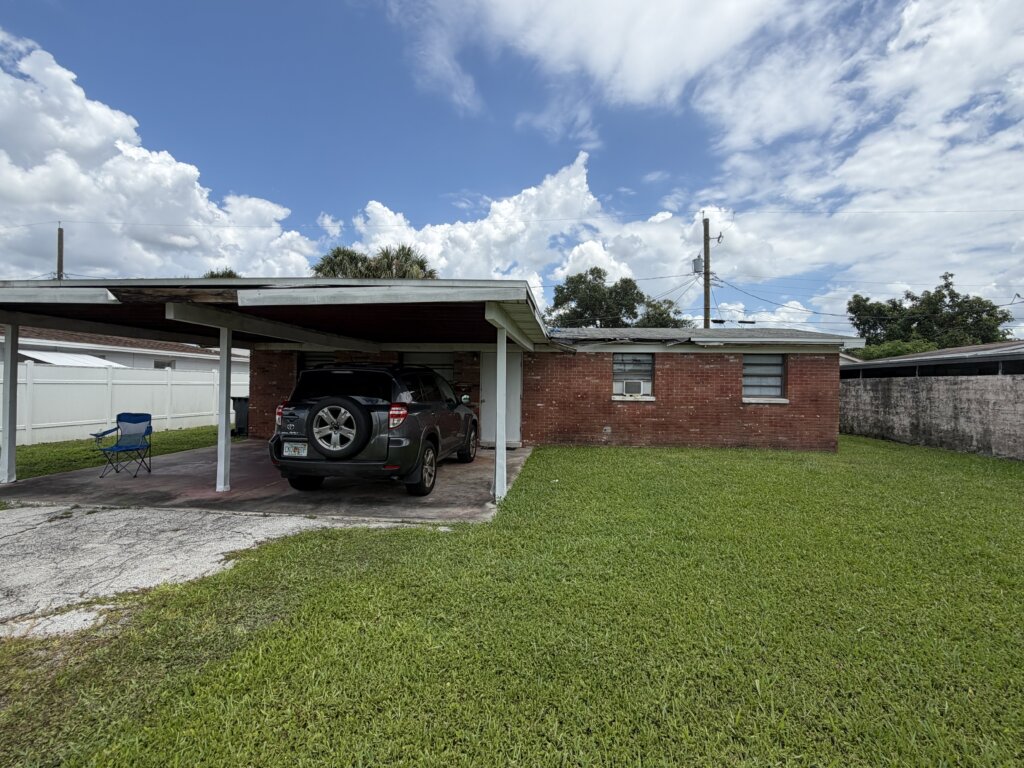
Six siblings inherited their mother’s home. She died in 2000. One of the siblings lived in the house for the entire twenty-five years since, and the family never completed probate — until a few weeks ago, when the sibling moved out and they finally pushed it through.
When the property was worth roughly $50,000 at her death and it’s selling for around $250,000 today, that’s about a $200,000 gain sitting on the table.
Nobody asked about taxes at the start. The question surfaced late — after they’d already turned down my cash offer and we’d started talking about listing it instead. Then out of the blue: what about taxes?
They weren’t thrilled with the answer, but they weren’t devastated either, and there’s a reason: the proceeds split six ways. A $200,000 gain divided among six heirs is a very different conversation than one person absorbing it alone.
Still — if that family had completed probate and sold in 2001, the gain would have been close to nothing.
Why the Date-of-Death Value Determines Your Tax Bill
If the step-up is what saves you, then the value on the date of death is the single most important number in the entire transaction. It’s the floor you measure everything from.
Here’s the problem: almost nobody gets that value documented. In most of the probates I’ve worked, the family never had an appraisal done at the date of death. It simply doesn’t occur to anyone in the weeks after losing a parent, and no one tells them it will matter later.
That’s fine when the death was recent — recent values are easy to establish. It becomes a real problem when the death was years or decades ago. You can’t look up a 2000 value on Zillow or Realtor.com; those platforms generally only go back five to ten years.
For an older death, the tool is a retrospective appraisal — a licensed appraiser establishing value as of a specific past date, using the comparable sales that existed at that time. It costs a few hundred dollars and it produces something defensible, which matters if the IRS ever asks how you arrived at your basis. County property appraiser records can also help establish historical just/market values, though an assessment isn’t the same thing as an appraisal.
Honestly, I’d never recommended a retrospective appraisal before this deal. Nobody had ever asked me about it. It’s the kind of thing you only learn matters when it lands in front of you.
If you’ve recently inherited a property: get the date-of-death value documented now, even if you’re not selling yet. It’s cheap and easy today and expensive and difficult in ten years.
Florida Capital Gains Rules on Inherited Property
Florida has no state income tax, so there’s no state capital gains tax on the sale. Whatever you owe is federal.
Florida has no state estate tax or inheritance tax. Federal estate tax exists but the exemption is high enough that the overwhelming majority of families never encounter it.
Inherited property always gets long-term capital gains treatment, regardless of how long you actually owned it. Even if you sell three months after inheriting, you get long-term rates rather than short-term.
Selling costs reduce your gain. Commissions, closing costs, and certain improvements come off the top before the gain is calculated.
What is the 2-Year Rule for Inherited Property?
People search this constantly, and it’s usually a mix-up of two different things.
What most of them mean is the primary residence exclusion — if you live in a home as your main residence for two of the previous five years, you can exclude up to $250,000 of gain ($500,000 for a married couple filing jointly). That’s a general tax rule, not something specific to inherited property, but it can apply to an heir who moves into the house and lives there long enough.
That does happen. I worked with a family in Brandon where the younger sibling didn’t have a job or much money, so after their father died he moved into the house. He lived there a couple of years before deciding it needed more work than he could handle, and eventually sold it to me.
Whether that exclusion actually helps in a given situation depends on the specifics, and it’s exactly the kind of question to put to a CPA rather than a blog post.
Is It Better to Keep or Sell an Inherited Property?
This is the question underneath the tax question, and it deserves a real answer rather than a sales pitch. Here’s how I actually look at it.
Keeping makes sense when:
- The mortgage payment is low, or the property is free and clear
- The house is in good condition and will pass a 4-point inspection, meaning you can actually get insurance on it
- You want to live there, and the taxes and insurance cost less than renting somewhere else would
- Or you’re willing to be a landlord and the rent exceeds the mortgage, taxes, and insurance
If the house is owned free and clear and in great shape, I’ll tell an heir that directly. There’s no reason to take a cash offer from me that’s below market when you could live in it, or list it on the open market and make considerably more than I’m willing to pay. I’ve said exactly that to families more than once.
That’s exactly what happened with one Tampa family whose inherited home sold for $15,000 over asking.
Selling to a cash buyer makes sense when:
- The house needs a roof, has mold, has leaks, or the A/C doesn’t work
- It won’t pass a 4-point inspection, which means a financed buyer can’t get insurance and therefore can’t buy it
- You don’t have money to make repairs and don’t want to borrow it
- You need to be done quickly
- There are bills piling up and time isn’t a luxury you have
Everybody’s situation is different and you never know what someone is dealing with. But if none of those pressures apply, keeping the property or selling it at full retail is genuinely the better move.
The Cost of Holding an Inherited House in Florida
Here’s the part almost nobody calculates, and in my experience it dwarfs the tax question.
Carrying costs. An empty inherited house in the Tampa area can run $7,000 to $10,000 over six months in taxes and insurance alone. Add HOA dues and it climbs from there. That’s money leaving the estate every month while everyone decides.
Code violations. Nobody’s cutting the grass at a vacant house. I’ve seen inherited properties sit empty for years while violations stacked up, and I’ve seen those fines reach five figures — for not mowing a lawn. Those get paid out of the sale proceeds eventually. Somebody always pays.
Deterioration. Vacant houses get worse. Roofs fail, plumbing leaks, A/C units die, and the property that would have passed a 4-point inspection two years ago no longer does. When those families finally sell, they get less than they would have gotten the year they inherited it. I’ve watched it happen repeatedly.
Family friction. One heir is simple. Six heirs is a negotiation. When one sibling is living in the house and the other five want to be paid, the pressure builds — and if the occupant can’t afford the taxes or the mortgage payment, it gets dangerous fast. Unpaid taxes can lead to a tax deed sale. An unpaid mortgage leads to foreclosure. And if the property forecloses, that foreclosure can land on every heir’s record, not just the one living there. Nobody benefits from that outcome.
Disaster risk. This is the one that still bothers me. A family inherited a house worth roughly $500,000 and didn’t sell. Then the hurricanes came through. The house flooded, and they had no insurance on it. They ended up selling for around $200,000 — essentially land value.
They lost $300,000 by waiting.
When Should You Sell an Inherited House?
Here’s what makes this topic unusual: the tax answer and the practical answer are the same answer.
If you sell an inherited property shortly after the death, your basis and your sale price are nearly identical, so your capital gains exposure is close to zero. You also avoid every carrying cost, every code violation, every failed A/C unit, every hurricane, and every year of family disagreement.
If you hold it for twenty years, you accumulate a taxable gain and you absorb all of that risk.
So unless you have a specific plan — you’re going to live in it, or you’re going to rent it out and it cash flows — selling reasonably soon after you inherit is usually the right move on both counts.
Two practical steps if you’ve recently inherited:
- Get probate moving. You can’t sell until the estate has authority to sell, and delay only extends every one of the costs above.
- Document the date-of-death value now, while it’s easy and cheap.
If You’ve Inherited a Property in Tampa Bay
I buy inherited homes for cash, as-is, with no repairs and no cleanout required. I’m also a licensed Florida agent, so when listing the property will net your family more than a cash offer, I’ll run both sets of numbers and tell you that honestly — the same way I’ve told other families to keep their house or sell it retail rather than take my offer.
Either way you’ll have real numbers instead of a guess.
Mike Youngblood A+ Home Buyers Tampa, FL (813) 200-7665
Again: this is general information, not tax or legal advice. Talk to a CPA about your specific situation before making decisions based on tax consequences.